

The Wrong Customer Can Look Exactly Like the Right One
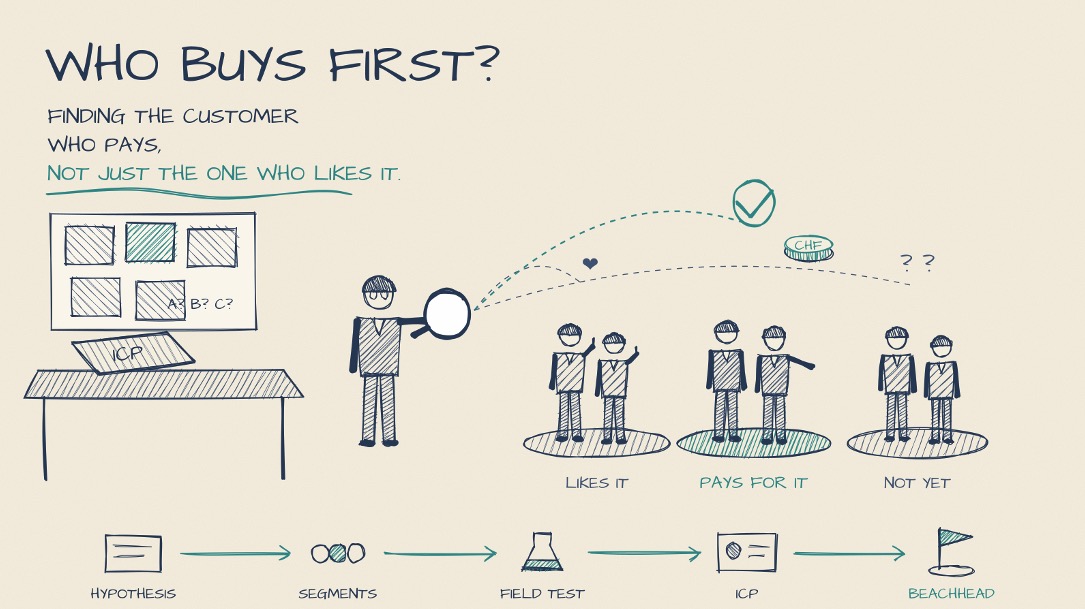
A step-by-step guide to the template Market & Customer Definition in 8 Steps, with lessons from founders of seven Swiss start-ups. Part 2 of the Founders Hive series on go-to-market, commissioned by Innosuisse.
SmartHelio, which predicts failures in solar plants, first pitched its software to the people who would use it every day: asset and operations managers. The tool could help them a lot. They had no budget for it. “We realised this quite late,” says co-founder Govinda Upadhyay. Today SmartHelio sells top-down, through management.
Most founders can name several possible customer groups. The hard part is deciding which one buys first, and recognising it before you spend months on the wrong one. The template guides you through this in eight steps, one worksheet each. Below is what each step asks of you, and which founder learned it first.
The numbers
- Four to six segments. That is how far Bill Aulet, author of Disciplined Entrepreneurship, suggests narrowing your list of candidate segments before you pick one.
- Nine decision makers. Stellos AG counted that many people involved in the process around a single parking space.
- 30 seconds. That is how long LatticeFlow AI needs to place a new prospect on its own maturity scale.
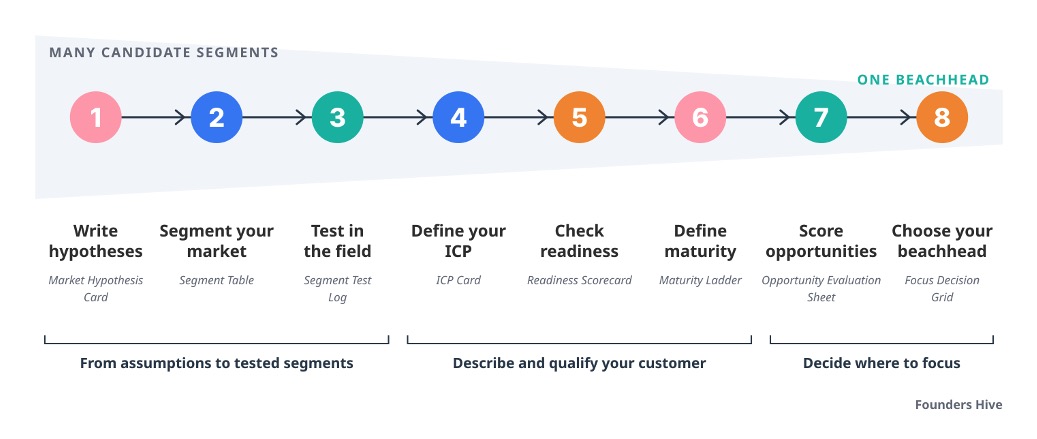
Step 1: Write your market as a bet
Treat every statement about your market as an assumption that can fail. Risklick, which helps pharmaceutical companies design clinical trial protocols, saw four possible customer types: pharma, biotech, contract research organisations and medical device makers. Instead of choosing on paper, the team tested the product with all four, to see “who feels the pain more and who gains more from our solution,” says founder and CEO Dr Poorya Amini.
- Worksheet Market Hypothesis Card: We believe that, We test it by, We are right if, Deadline. Fix what counts as success before you test.
Step 2: Segment by need, not only by industry
A segment is a group of customers who share a need and can be reached the same way. Industry alone is not enough. SmartHelio found that solar companies keeping plants on their balance sheet wanted its software, while companies that build plants to sell them did not. “They were not my customer, and that took me time to understand,” says Upadhyay.
- Worksheet Segment Table: Segment, Need, Size, How we reach them. A real segment passes Aulet’s test: its customers buy the same product, buy it the same way and talk to each other. Size it bottom-up: customers you can reach, times realistic revenue per customer and year.
Step 3: Test segments in the field
Desk research tells you who could buy; only a test shows who will. Tethys Robotics, which builds autonomous underwater robots, started with police organisations and hydropower operators in Switzerland because they were close by and allowed fast, cheap iterations. CEO Jonas Wüst still looks for people open to a test “not in half a year, but maybe in three weeks.”
- Worksheet Segment Test Log: Segment, Test, Signals seen, Why it advanced or stalled. Watch for pain, speed and commitment. Tethys writes down the two main reasons for every decision and does not run pilots for free.
Step 4: Describe your ideal customer
Your Ideal Customer Profile (ICP) describes the type of organisation that gains most from you; your personas describe the people inside it. SmartHelio qualifies prospects with two indicators: a large solar portfolio that grows fast, and too few people in operations. Stellos AG, whose software helps real estate owners manage and rent out parking spaces, had to learn the daily problems of all nine decision makers it identified.
- Worksheet ICP Card: basic fit, two indicators you can check before the first call, and one disqualifier. Then name three people: who uses it, who pays and who decides.
Step 5: Check if one customer is ready now
Need is not enough; the customer must be able to act. heyPatient AG, founded by Regula and Matthias Spühler, digitises the patient journey for hospitals. It looks for three conditions: management focuses on the topic, the internal systems are ready, and the culture wants digital contact with patients. It also times its pitch: when a hospital has to upgrade a core system anyway, adding heyPatient costs little extra effort.
- Worksheet Readiness Scorecard: score leadership, systems, culture and budget from 1 (no) to 5 (yes) for one named prospect, with evidence for each score.
Step 6: Define maturity in a new market
In an established market, you can see who buys and what they spend. In AI governance, companies were still deciding which roles to hire and whether they need software at all. LatticeFlow AI therefore defined its own maturity criteria: is a team assigned, are governance rules defined, how many AI use cases are deployed. “Once you define this, it’s quite systematic,” says CEO Petar Tsankov.
- Worksheet Maturity Ladder: Level, Typical signs, What they need, Our offer. Expect few prospects at the top: innovators and early adopters make up about 16 per cent of a market. In an established market, skip this step.
Step 7: Score opportunities, not impressions
Two good conversations in one week can pull a whole team in the wrong direction, Tsankov warns. Scoring every prospect on the same criteria protects you. It also reveals hidden costs. Mateusz Wojdyło of Stellos AG found that convincing a single small business owner took a month or two, as long as a large company. “It’s still one person,” he says. Stellos went after the largest real estate owners.
- Worksheet Opportunity Evaluation Sheet: score value, access, effort and leverage from 1 to 5 for each named prospect. Agree first what a 1 and a 5 mean. Plot value against effort and start top left.
Step 8: Win one beachhead first
A beachhead is the first segment you aim to dominate. Focus can mean going narrower than feels comfortable. macu4, which makes 3D-printed prosthetic and orthotic devices, built a product for “the niche in the niche.” CEO Myriam Lingg says the strong position there opens doors with partners and helps in other markets. Geoffrey Moore explains why: four or five customers in one segment create word of mouth, one or two in each of many segments do not.
- Worksheet Focus Decision Grid: Segment, Win now?, Leads to, Decision (now, later, drop). Focus is not forever: Tethys moved from nearby hydropower to offshore energy once it saw where the larger potential was.
The shortest version
- Write your market as bets that can fail, each with a deadline.
- Segment by need, and check that customers in a segment talk to each other.
- Test with real customers; only pain, speed and commitment count.
- Separate the user from the person who pays.
- Score every prospect on the same criteria, then win one segment before the next.
The template Market & Customer Definition in 8 Steps is available from Founders Hive. Fill in Steps 1 to 3 this week.
Founders Hive produces this series as part of the Innosuisse Entrepreneurship Training programme. Featured founders: Mateusz Wojdyło (Stellos AG), Regula and Matthias Spühler (heyPatient AG), Jonas Wüst (Tethys Robotics), Petar Tsankov (LatticeFlow AI), Poorya Amini (Risklick), Govinda Upadhyay (SmartHelio), Myriam Lingg (macu4).
Methods: Bill Aulet, Disciplined Entrepreneurship, 2nd edition (2024), Step 1; Everett M. Rogers, Diffusion of Innovations; Geoffrey A. Moore, Crossing the Chasm. Founder statements are drawn from interviews conducted for this series.