

Tethys Robotics: Jonas Wüst Builds Underwater Robots in a Country Without a Sea
In June 2019, a robot called Scubo 2.0 was on its way to Tennessee, packed in a large metal crate. The eight ETH Zurich students who built it had spent a year on it in the Student Project House. On some days they had stayed in the swimming pool until three in the morning, only for the housing to leak. By the time ETH News reported on them, the leaks were fixed, and the team was about to compete as the first Swiss entry at the MATE International ROV Competition in Kingsport.
One of the eight was Jonas Wüst. Seven years later, he is CEO of Tethys Robotics AG, an ETH Zurich spin-off that builds underwater robots for murky water and strong currents. In September 2025, the jury of the Top100 Swiss Startup Award ranked the company sixth, the highest position of any robotics startup. In October, it closed a pre-seed round of EUR 3.5 million. Its customers are now increasingly offshore, a long way from a country without a sea.
The Person Behind Tethys Robotics
Wüst is a mechanical engineer and an ETH Zurich graduate. In his interview for the Founders Hive series, he says the wish to take things into his own hands came early. After the first two years of mechanical engineering, he and his later co-founders wanted a project they could control themselves. They went on to write their bachelor’s and master’s theses on it.
That background still shapes how he describes the team. “We have no PhDs whatsoever,” he says. They never saw themselves as lab people working in an office. They built prototypes for real applications early, took them into the water and broke many robots or robot parts. Almost everything that can happen underwater, he says, happened to them at least once, and that is how a hardware team learned to move fast.
Pragash Sivananthaguru, then an electrical engineering student, joined through an acquaintance, according to the ETH Zurich Foundation. In 2022, he and Wüst were accepted into the ETH Pioneer Fellowship programme. Today Tethys has seven co-founders: Wüst as CEO, Sivananthaguru as CTO, Johannes Lienhart as COO, Andrej Studer, Bastian Schildknecht, Florin Kümin and Gallus Kaufmann.
Seven founders is an unusual set-up. Wüst says it is not an obvious choice for founders, and even less so for investors. For him, what counts is having the right people with the right motivation, because deep tech needs resources and time: “it’s not a sprint. This is a marathon building robots.”
Genesis of the Idea
The start was not a business plan. “We just wanted to build a robot,” Wüst told the ETH Zurich Foundation in 2023. Switzerland has a lot of robotics, he explains, mostly in the air and on land. The students wanted to try it underwater, where the field was less advanced.
They did not start from zero. Master’s students had already built a diving robot in an earlier ETH Focus Project, and the Scubo team used their material and know-how, ETH News reported. At the competition in the USA, the students finished in the top ten. They named their project after Tethys, a Greek goddess of the sea.
The next push came from outside. The Swiss Army’s unit for explosive ordnance disposal and mine action contacted the team. It needed a way to recover people and objects from murky or dangerous water without endangering divers. After two years of joint work, the team handed over its Proteus prototype in May 2022, a robot originally designed for pool environments.
Meeting rescue divers made the problem concrete. In a 2025 Venturelab article, Wüst recalls that divers were still being sent into low-visibility water to inspect wrecks, recover objects or deal with unexploded ordnance. “We realized how outdated it all was,” he said.
The project grew within ETH Zurich. The team benefited from the environment of Professor Roland Siegwart’s lab, which had long worked on flying robots, and drew on findings from around 20 semester, bachelor’s and master’s theses. By 2023, it had tested its robot in the Rhine in Basel, where Wüst says diving is extremely strenuous. In September 2023, Tethys became a full project at Wyss Zurich and won CHF 150,000 in the final stage of Venture Kick. In 2024, the project became Tethys Robotics AG. Siegwart sits on its board of directors.
Tethys Robotics: The Solution
Tethys ONE, launched in August 2024, works in two modes. A pilot can steer it as a remotely operated vehicle (ROV), or it can carry out a mission on its own as an autonomous underwater vehicle (AUV). According to the company, it weighs 35 kilograms, is rated to 300 metres and runs for four hours on hot-swappable batteries. For stationary inspections, it holds position in currents of up to 3.5 knots, about 1.8 metres per second.
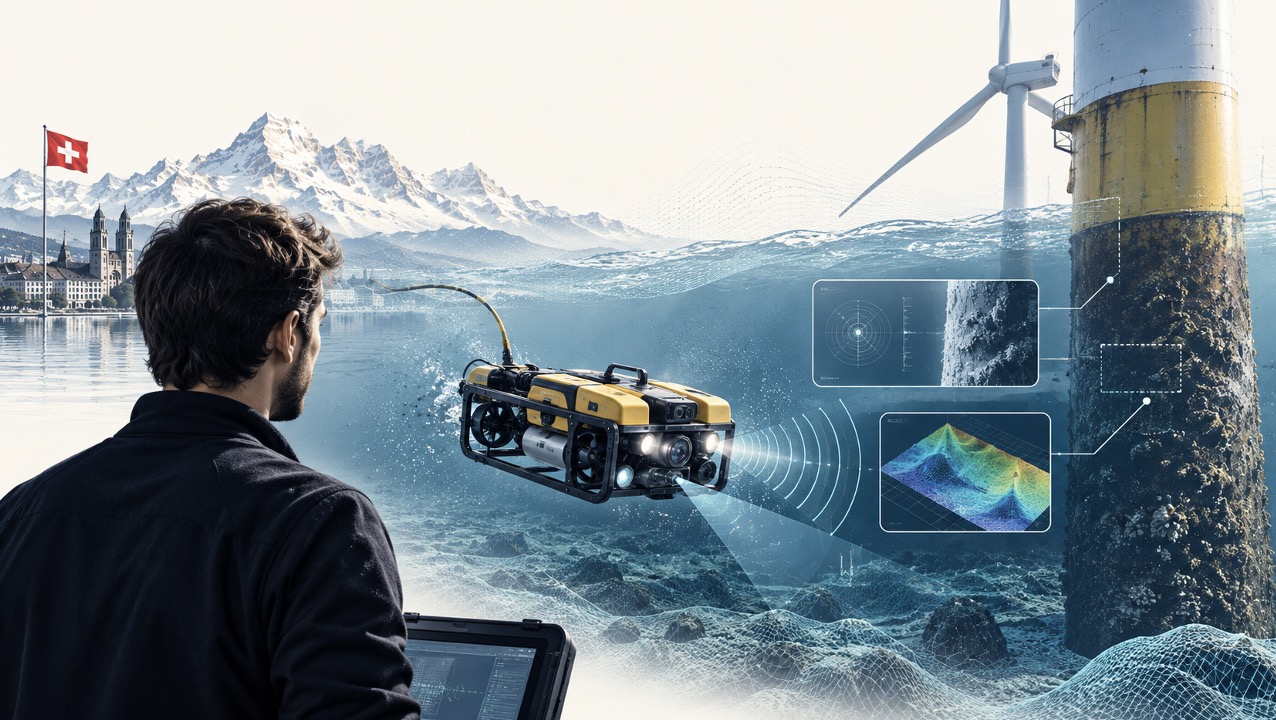
Holding position is the hard part. GPS does not work underwater, and cameras are of little use in turbid water. Tethys ONE therefore relies largely on sound. A Doppler velocity log measures the robot’s speed over the seabed from the frequency shift of acoustic signals reflected off the bottom. Sonar shows the pilot what lies ahead and below, even at zero visibility. A navigation unit on a vessel or a fixed structure combines satellite positioning with acoustic tracking to place the robot in global coordinates. With these data, the robot holds its position and depth, follows the terrain and builds 3D maps.
A case study on the company’s website shows what this means in practice. In a wind farm in the Baltic Sea, Tethys ONE was launched from a crew transfer vessel to inspect a monopile foundation. It followed a preset path ten metres above the seabed, then held distance and position for close checks of welds and anodes. The maps showed minor signs of scour around the foundation. The welds themselves were hard to assess because marine growth covered them. According to the company, setup took 16 minutes, and deployment, inspection and recovery took less than 90 minutes on site. It puts the setup time of a conventional work-class ROV at 24 to 36 hours.
The robot is modular. Payloads listed by the company include a metal detector, a magnetometer for locating submerged munitions, an ultrasonic probe that measures steel thickness through coatings and a manipulator arm. In December 2024, Tethys received the Gwyn Griffiths Underwater Robotics Award of the Society for Underwater Technology.
Market and Context
Wüst describes the market in plain terms. Offshore oil and gas assets, wind farms, cables and internet connections need regular inspection, and that work is still done by many people on many vessels. The aim is for robots to take it over, so that the people who work offshore today can come back. He calls offshore energy a very conventional industry. Tethys focuses on Europe, where almost every site is within a three-hour flight.
Switzerland faces an additional challenge in its own lakes. Between 1918 and 1964, around 8,000 tonnes of military munitions were sunk in Lake Thun, Lake Brienz and Lake Lucerne, according to a later Federal Department of Defence, Civil Protection and Sport update. Much of the ammunition is located at depths of 150 to 215 metres. An armasuisse ideas competition launched in August 2024 subsequently evaluated 214 proposals and selected prize-winning concepts for further investigation. This does not mean recovery operations have been approved or begun.
The buyers are often not the energy majors themselves. Wüst says Tethys talks to many inspection companies that work for the large operators, because they need a solution now and understand the daily job. In May 2025, Tethys announced a partnership with SeaRenergy, an offshore service provider, starting with pilots on wind farm structures and subsea cables in the North Sea and the Baltic Sea. In July 2025, it named SepcoTech as its partner and reseller in Denmark. In October 2025, Aramco Europe reported a successful demonstration of Tethys ONE on a Swiss lake. Tethys also works with the Swiss Armed Forces and the Swiss Drone and Robotics Centre. According to the company, more than 30 pilot projects had been launched by autumn 2025.
Challenges and Growth
The first customers were chosen for proximity. In the Founders Hive interviews, produced on behalf of Innosuisse, Wüst explains that Tethys began with police organisations and hydropower operators in Switzerland. They wanted to see and test the robot, and they were close enough for fast, cheap iterations. Once the team understood where the larger potential lay, it shifted to offshore energy. The approach stayed the same, but the distances grew: a customer who wants a test in three weeks may now be anywhere in Europe.
Visibility came before the product. With older prototypes, the team went to what Wüst calls the biggest exhibitions in London and said openly that a product was most likely two years away. The aim was to find out who would pilot with them. Cold outreach gave way to referrals, which Wüst says now bring the best progress. Offshore work runs on trust, and a Swiss company without access to the open sea first has to earn it. At exhibitions, the first contact is often someone who wants to sell something rather than someone who would use the robot, and it usually takes two or three steps to reach a decision maker.
Sales discipline came with experience. At first, Wüst says, the team simply went for it. Today it uses an evaluation sheet for each case to judge how much value it can add before a demo or pilot. One rule is firm: “we don’t do pilots or whatever for free.” A customer who travels to the Zurich office for a demonstration has shown interest and some budget. Then both sides define a pilot scope and what must be achieved for a letter of intent. Some customers moved from demo to pilot in two or three months. For one important pilot, Tethys waited more than a year. The tracking tool is an Excel sheet, not HubSpot. What matters, Wüst says, is to write down honestly the two reasons why a lead moves forward or stalls.
The hardest lesson was focus. The robot could serve police, hydropower or fish farming, and each made some sense. Narrowing down to offshore energy assets let the team concentrate its resources. Looking back, Wüst would have focused sooner, spoken to industry people earlier and gone out “even more brutally than we did”. He would also have put more robots into the field, because during development, learning speed depends on operating time.
Outlook
Redstone led the October 2025 round, joined by Euregio+, Alpine VC, Zürcher Kantonalbank, the ETH Foundation, Kickfund and Venture Kick. The company plans to use the capital to develop and scale Tethys ONE, roll it out internationally and grow the team. It also intends to deepen its work with security authorities and international organisations on explosive ordnance disposal. In early 2026, Wüst was selected for the Venture Leaders Mobile roadshow to Barcelona, and Tethys was also selected for the Venture Leaders Mobile 2026 programme. On the Swisspreneur podcast in July 2026, he explained why Tethys is putting more intelligence into the robot itself rather than using it only to collect data.