

Risklick: Poorya Amini Revolutionises Clinical Study Protocols with AI
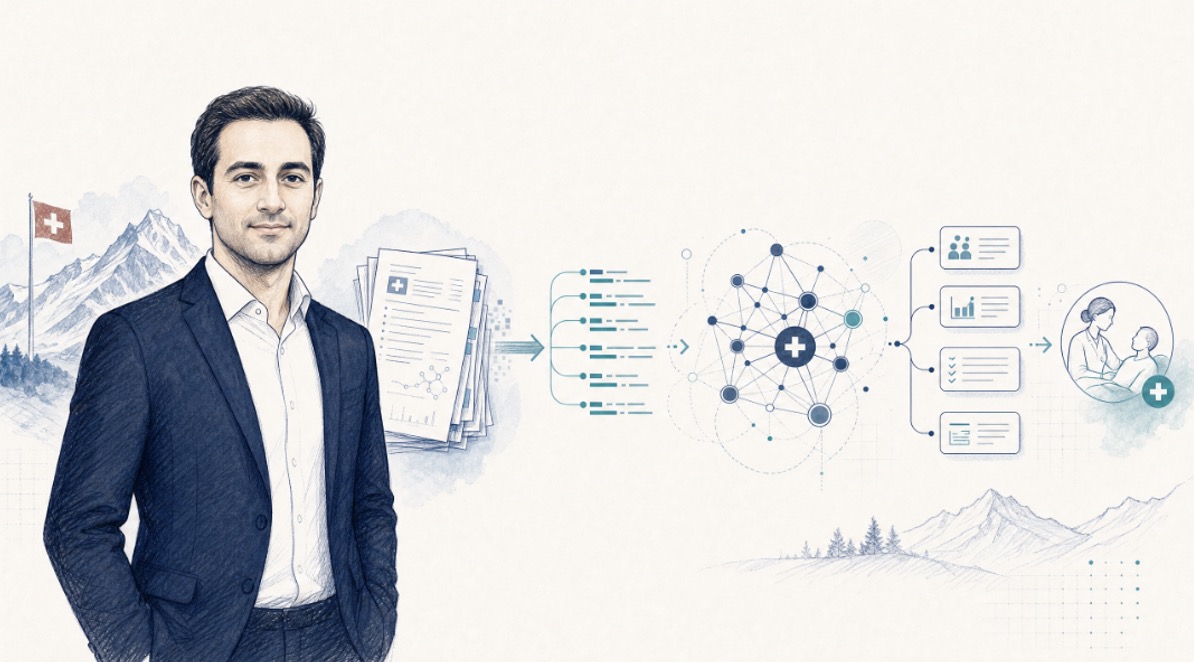
“My name is Poorya Amini, I’m the founder and CEO of Risklick. And this is my story,” begins Risklick founder Poorya Amini in the interview. In his mind he may be picturing a thick manuscript he worked on in his previous job as a project manager at a CRO (Contract Research Organization): a clinical study protocol. Such protocols — plans running to hundreds of pages that specify how a new drug is to be tested in humans — are laborious, time-intensive and expensive. Writing one alone takes an estimated 12 to 15 months. During this time, 10 to 20 experts from various disciplines frequently work together. And despite all the effort, the vast majority of studies fail: only around 10 percent of all clinical trials reach their objective. This realisation prompted Amini to rethink.
Working alongside other researchers at a pharmaceutical company and CRO, Amini came to know the dark side of the status quo. “In every clinical trial, 4 to 500 pages of protocol get in the way,” he says today. Errors in these documents can have “catastrophic consequences” — and they do have consequences: delays, cost explosions and, frequently, compromised patient safety. Amini recalls a time when he “was not happy with the way we do this”. From this personal frustration, the idea for Risklick matured: a software tool that supports experts in efficiently creating perfect study protocols, instead of laboriously writing them from scratch by hand.
The Person Behind Risklick
Behind Risklick stands the pharmacologist Poorya Amini, who holds a doctorate. Originally coming from the veterinary field, he completed his doctorate at the University of Bern — a background that is rather rarely found in startup portraits. After his studies and dissertation, Amini worked as a project manager at a CRO, where he coordinated clinical trials. There he experienced first-hand how much time and resources go into the creation of study protocols alone. This practical experience shaped his motivation: he saw a severe bottleneck in the system and wanted to eliminate it.
Amini describes his motivation as follows: he wants to “increase the probability of study success and bring new therapies to patients more quickly”. This mission sounds ambitious, but it is based on concrete experience and a vision: thanks to AI, protocols could be created “in just one day”. Initially, however, his idea was unpopular. As the founder recounts, at first no one believed in his concept. Several investors expressed doubts that major players in the industry could outmanoeuvre him. Amini nonetheless remained persistent — a principle he later described as the most important lesson: “Stay committed to your vision – realistically and persistently”. Years later, even large pharmaceutical companies were using his platform, despite having initially developed their own solutions. This underpins his belief that the technical depth and agility of a small startup can often achieve more than the size of established corporations.
Genesis of the Idea
The idea for Risklick arose from a very personal “pain point”. At the CRO where Amini worked, he saw every day how standardised and outdated tools were being used. “I asked many experts in the industry whether there was a better way — but everyone said: ‘No, this is how we do it’,” he recalls. At some point it became clear to him: if no one else does it, he would simply have to do it himself.
Starting from this unsolved problem, Amini initiated a feedback loop of experimenting and learning. He began developing a prototype based on Artificial Intelligence (AI). In doing so, he relied on collaboration from an early stage: first customers from industry and research were persuaded to conduct pilot projects with his software in order to demonstrate its value. In his own words, “real use cases” in the industry convinced sceptical observers, because they made it possible to concretely measure the time savings and quality improvements that Protocol AI delivers.
In parallel, he systematically acquired the necessary know-how. He attended workshops in the DayOne Accelerator Programme in Basel (participant cohort 2023/24) and consulted experienced coaches on marketing and sales. This support helped to map out a sales funnel: who are the potential customers, how does one reach them, who within a large corporation is the right contact person? Such questions can be laborious for a B2B startup — particularly in the regulated pharmaceutical industry. Amini emphasises: “The challenge is great, it is a complex market. You have to use the right network in order to get doors opened at all.”
On the organisational side too, he laid the foundations for scaling at an early stage. “Self CRM from day one” was his maxim — already in the development phase, the team maintained all contacts, emails and leads digitally in a single system. Nothing slipped through the cracks, and interested parties could not be lost during critical phases. Transparency and traceability helped to deploy the team’s limited resources efficiently.
Risklick: The Solution
Risklick’s product is called Protocol AI™ and promises exactly that: significantly faster and more precise creation of study protocols. Technically it is based on methods of Artificial Intelligence — more specifically on Natural Language Processing (NLP) and Large Language Models. The software “draws” relevant knowledge from vast databases: according to the provider, Risklick uses more than 800,000 past studies, regulatory documents and publications to systematically evaluate protocol templates and best practices. A user can then enter the parameters of a new study — such as the therapeutic objective, patient numbers, comparison arms — and the AI automatically generates an initial protocol draft. This can then be further refined within the team.
The tool guides experts through the process step by step:
- Analysis — First, all relevant study design elements are systematically evaluated.
- Design — The user then optimises the study design by generating and comparing multiple scenarios.
- Development — Finally, the AI creates the protocol draft on the basis of these specifications, automated and precisely tailored.
This procedure is intended to dramatically increase efficiency. According to company statements, Protocol AI reduces protocol creation time to a few weeks and thereby saves millions. Because the software is based on current data, the substantive quality of the protocol is simultaneously improved. In the best case, this also reduces the rate of costly protocol amendments, which cause additional delays to studies.
Risklick’s approach is “evidence-based”: the AI delivers valid parameters and citations from studies, rather than merely generic text modules. Experts see AI here as a “co-pilot” that takes work off their hands, but they always retain control. “AI in our field is a supporting tool, not a replacement for human expertise,” Amini emphasises. In this sense, he wishes to use Protocol AI not so much to revolutionise the field as to professionalise it: fewer errors, less gut feeling, more data and traceability.
Market and Context
Risklick is at the pulse of a growing development. Worldwide, intensive discussions are taking place about how AI and digitalisation can accelerate the pharmaceutical research process. At the same time, clinical trials are an enormous source of cost and time. New therapies take an average of ten years and up to 2 billion dollars in development expenditure. Every month that can be saved is real money — and also means faster benefit for patients.
That Protocol AI is not a mere future vision is demonstrated by initial partnerships: Risklick was admitted to the portfolio of the Swiss pharmaceutical company Debiopharm via its Innovation Fund in April 2024. Debiopharm praises how the tool can improve internal processes in R&D and Regulatory Affairs. These deals point to Risklick’s customer segments: pharmaceuticals and medical devices, biotech, CROs — essentially all those who plan and conduct clinical trials.
The MedTech sector currently forms a distinct field of application. In January 2025, Risklick presented a version of Protocol AI tailored to medical devices. There, average development times from idea to market launch range between 3 and 7 years, and clinical trials can sometimes take 6 months for protocol creation alone. Until recently, many small MedTech companies lacked standardised tools for this — a problem that Risklick is now addressing.
Internationally, Risklick is not alone: there are a handful of other startups targeting AI in study planning. However, Risklick positions itself as a bridge between data and experts — which is why the company advertises its claim to set a “new standard”. CEO Amini puts it succinctly: “Our mission is to increase the probability of study success and bring new therapies to patients more quickly. Our vision is to become the standard for study protocols, so that studies run faster, more cheaply and more safely.”
Challenges and Growth
The path from idea to market readiness was shaped by typical founder hurdles. Amini describes how the topic of study design long failed to receive the attention it deserved. When discussions about new guidelines and digital transformation finally emerged in the industry, Risklick was able to “pull” its concept into the conversation. Until then, the team had to do persuasion work. Instead of standard market research, Amini relied on learning by doing: with first customers he conducted workshops, gathered feedback and improved the product. “We found out which customer segment advances our product the most, and then focused on it fully,” he describes the approach.
Networking was also important: in the regulated pharmaceutical industry, recommendations from other decision-makers open doors more quickly than cold acquisition. Initially, Risklick needed “some references to gain traction”. A pilot trial with a mid-sized pharmaceutical company succeeded: the team was able to demonstrate concrete savings there and thereby spark the next interest. Further conversations followed thereafter.
In January 2026, Risklick announced an important milestone: a partnership with Norstella, a Citeline subsidiary (formerly Pharmapremiid). Together with Citeline, an end-to-end system is to be created that covers the entire process from protocol creation through operational planning to regulatory submissions. In the context of this cooperation, Amini formulated an ambitious goal: “Our mission is to enable the pharmaceutical industry to design a clinical trial in just one day”.
Outlook
Risklick thus stands on the threshold of the next growth phase. At the start of the year, the team was able to announce that Debiopharm and further partners are deploying the software on a broader scale. Financial injections from the Debiopharm Innovation Fund and other sponsors have secured the development. On the product side, the platform was formally launched for pharma in 2024 and for MedTech in 2025, and following the completion of pilot projects it is now likely to be deployed in real-world use soon.
While industry observers are watching with anticipation to see whether AI can truly transform clinical research, Amini believes in a fundamental change. Even today, the success rate of clinical trials stands in the single-digit percentage range. He expects that new methods — from “in silico” simulations and digital twins to powerful AI — will significantly improve efficiency in the coming years.
His message remains pragmatic: AI helps researchers to work faster and better — but it is no panacea. In future, Risklick therefore intends to continue working closely with users in order to feed the software with new data and demonstrate its results in real-world studies. “If we can prove that we genuinely save time and make studies more successful, the market will follow,” says Amini. The plans for the coming months therefore encompass above all further cooperations and the expansion of the protocol database.
For the pharma and MedTech industry, this could mean: shorter waiting lists for patients and earlier access to innovations. “We want to create an ecosystem in which the path from study design to implementation is digitally connected,” explains the founder. If the plan works out, pharmaceutical companies could in a few years genuinely design study start plans “in just one day” — which would benefit not only the makers of Risklick, but ultimately millions of patients as well.