

macu4: Myriam Lingg Rebuilds the Path to a Prosthetic Arm
On 1 November 2022, the Swiss TV channel 3+ broadcast the fifth episode of the new season of “Die Höhle der Löwen Schweiz”. Among the pitches was a modular, 3D-printed forearm prosthesis, presented by Myriam Lingg and her co-founder Lukas Schiller of the Zurich startup macu4. With them on screen was Michel Fornasier, known to the Swiss public as “Bionicman”. Two investors, Roland Brack and Bettina Hein, made a joint offer: CHF 300,000 for 10 per cent of the company. A day later, Startupticker reported that the deal was signed and formed part of a closed seed round of almost CHF 700,000.
The money was only part of what the team wanted. According to Startupticker, the founders were also looking for know-how in online retail, company building and digital health to roll out their own webshop. Lingg told the portal that macu4 had started selling in July and had delivered more than 20 prostheses to users in Switzerland, Germany and Italy. Because the company serves a niche market, she said, it had to be able to sell in the EU from the start; a German subsidiary was set up for that purpose.
The Person Behind macu4
Lingg came to prosthetics from the business side. In a published interview with the consultancy Vendbridge, she describes studying business administration in Passau, Germany, before moving straight into medical technology: first as product manager for bone cements, then in sales for Latin America, and later as head of marketing for trauma and orthopaedic products in Mexico. Vendbridge names Heraeus and Smith & Nephew as her employers in Germany and Mexico. Mexico, she says, was a shock in culture, language and role at once, because she no longer had the cushioning of a corporate group.
After moving to Switzerland, she earned a doctorate at the University of Basel in 2017 on orthopaedic medical devices in Mexico, according to Vendbridge. The Swisspreneur podcast describes it as a PhD in epidemiology from the Swiss Tropical and Public Health Institute and names the European Center of Pharmaceutical Medicine and the think tank W.I.R.E. as later employers. Today she is CEO of macu4 and president of its board of directors.
Genesis of the Idea
Founding a company was never her plan. In her Founders Hive interview, she says she never wanted to found one and liked working in a large corporate environment. Yet after the move to Switzerland, she told Vendbridge, she did not want to go back into a corporation. Employers were confused by her mix of product management, marketing, international experience and a doctorate, and saw her as a hybrid between management and research.
So she turned to digital and mobile health, went to trade fairs and met startups. By coincidence, she says, she got to know people working on a prosthetics project at ETH Zurich, and joined it. She found a team without much structure and a technology that had been presented without imagination. Changing that was what attracted her.
Then the project failed. According to Lingg, not because of the team’s work but because it was tied to another matter that left it no room. She was ready to give up. A colleague from the project insisted on continuing. After some hesitation she agreed, on her own conditions. Her caution had roots: she had seen at close range how quickly self-employment can go wrong.
The founding team comprises Lingg, Lukas Schiller and Alec Chevrot, as also documented in a 2024 genisuisse interview. According to macu4, Schiller and Chevrot have both worked on prosthetic and orthotic medical devices since 2020; today Schiller is CIO, responsible for technological innovation, and Chevrot is CTO. macu4 AG was entered in the commercial register in June 2021, with its seat in Zurich. The venture had already begun taking shape as a project in 2020; this should not be confused with the legal incorporation date.
Venture Kick provided the first external money. In April 2021, macu4 won the programme’s first stage and CHF 10,000; in September 2021 it also won the second stage, for which Venture Kick offers CHF 40,000. The pitch addressed a blunt problem: many people with a forearm deficiency reject the prostheses on offer as expensive, heavy and uncomfortable, and there were almost no solutions for sport, which puts children at a particular disadvantage. In September 2021, the team planned its market launch in the DACH region for the first quarter of 2022. Sales started in July 2022.
macu4: The Solution
macu4 chose a segment that gets little attention: passive functional prostheses. They have no moving parts, Lingg explained to Vendbridge, but become useful in contact with something else, for example when cycling or kayaking. She chose this class because it had seen little innovation.
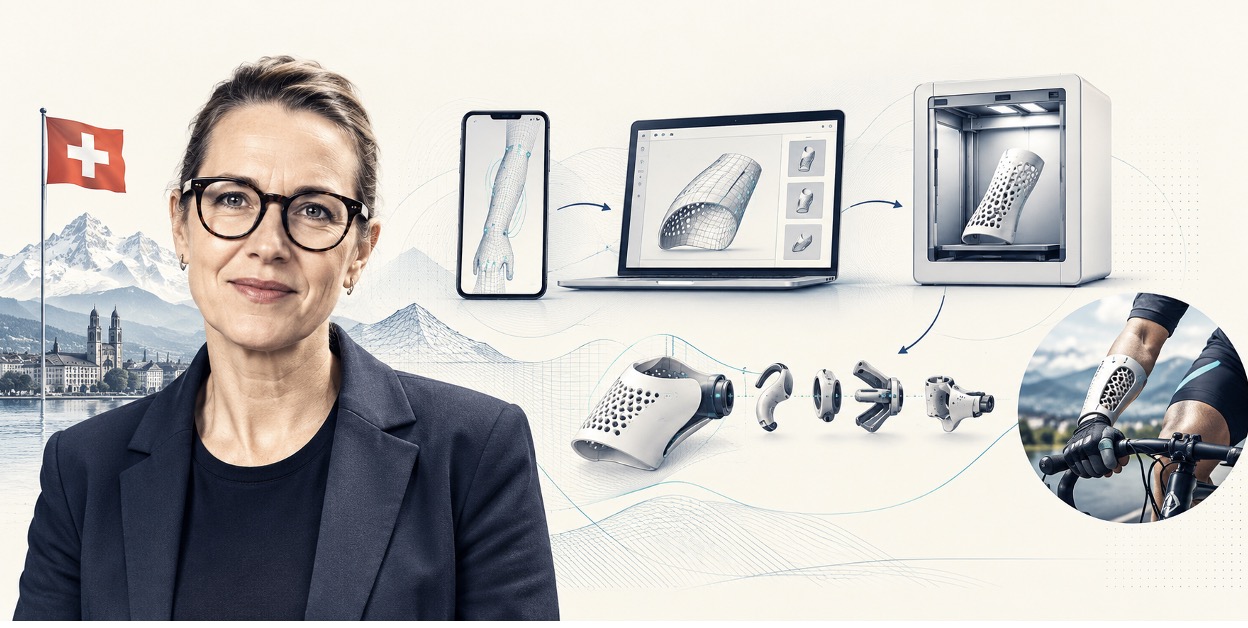
The Explorer System, the first product, is a modular forearm prosthesis for people with a forearm deficiency, with or without a wrist. According to the company, the personalised socket is configured using measurements derived from photos or scans, the 3D printed system weighs less than 300 grams, and a lacing system makes it easy to put on and take off. Modules called Bike, Swim, Ball, Hold, Twin and Pinch adapt it to different activities.
Two more product lines followed. The Lynk System is a modular hand orthoprosthesis for children, adolescents and adults with limited grasping function. The Lumo System is designed for young children with limited or no grip function and, according to the company, weighs about 100 grams. A Lynk Rest Module adds an option for positioning the hand and fingers.
The less visible innovation lies in the process. In 2022, Startupticker described how macu4’s software turns measurement points into a 3D print file for an individual prosthesis. The company has stated that its automated approach can reduce prosthesis costs by up to 75 per cent; this is a company-reported estimate rather than an independently established average, which matters most for children, who outgrow their devices. At its core, Lingg says, macu4 runs a direct-to-consumer model in a field dominated by business-to-business sales; orthopaedic technicians can also use and sell the parts macu4 prints. macu4 AG handles sales in Switzerland, macu4 GmbH sales in Europe and the USA.
Market and Context
macu4’s own figures show both the need and the size of the niche. In September 2021, the team told Venture Kick that up to 80 per cent of potential users of passive forearm prostheses do without one, many because of the cost, and estimated around 970,000 people with forearm deficiency worldwide. These are company estimates.
Reimbursement is a structural obstacle. Lingg told Vendbridge about customers who want the prosthesis even though their insurer will not pay; one wrote that it was the only prosthesis of its kind he would accept. At the same time, influential specialists told the team that its model does not fit the reimbursement system, especially for the personalised socket, which an orthopaedic technician normally buys as a semi-finished part, adapts and bills.
Perception is the other obstacle. Some markets still doubt that 3D printed products can perform well mechanically, Lingg says; macu4 saw this in Germany three years ago and recently in another market. Some customers still think the products are only for children, although the portfolio now also serves adults. Her lesson: such thinking cannot be forced to change; you have to wait for it.
Challenges and Growth
The daily reality has not changed much, she admits. You start with an idea, do your homework, and then “you wake up every morning and you think, how should I manage the day to day?” Fundraising is a constant: “It’s not easy to fundraise on the field of low tech technology.” Explaining the company is hard as well, because macu4 does not rest on one technology but on a set of them, visible to customers at the front, with intellectual property in the back end.
The portfolio itself caused friction. Developing Lumo, a niche product within a niche, looked questionable to outsiders. Lingg argues it strengthened the business relationship with the US and opened doors with partners in certain EU countries. Existing shareholders were at times irritated by new products and new markets; her reasoning is that when one market is not ready, you need the next one to gain time. The US shows how plans shift: macu4 now sells there, to a type of customer it had not expected. “It depends what the market tells you and then you adapt your plans.”
Public funding helped. Innosuisse approved a macu4 project in the 2023 call of the Swiss Accelerator, a transitional measure for Horizon Europe; the 33 approved projects received CHF 60.4 million in total, while macu4’s share has not been published. In August 2025, after macu4 completed Innosuisse Core Coaching, the Innosuisse Innovation Council awarded the company the Innosuisse Certificate in recognition of its progress.
On its startup.ch profile, macu4 lists the launch of the Lynk System in January 2024, market access in Slovenia in February 2025, the launch of Lumo in July 2025, and market access in the Nordic countries in August and in the USA in November 2025. Lingg has described macu4 as being present in 16 countries; this figure is attributed to her account and should be treated as a time-specific statement rather than independently verified current coverage. The team is selective about whom it sells to: “we rather have not a customer than an unhappy customer,” she says, which is why it invests in managing expectations.
In January 2024, macu4 also signed a partnership with the EnableMe Ukraine Foundation for a prosthesis sponsorship programme for people in Ukraine. According to macu4’s programme page, the two partners finance it alone.
Outlook
Lingg is clear about what drives her. An exit, she told Vendbridge, does not interest her much; what matters is that the technology exists and succeeds, and in the long run it may fare better inside a larger structure. Her advice to founders focuses on the team. Lingg has stressed the importance of maintaining strong co-founder relationships over time. “We still like each other,” she says. She recommends clarifying expectations at the start, including who is available to work weekends, and holding regular reflection meetings in which co-founders say openly what is not working. She also argues for planning with scenarios, even though investors tend to prefer a single best case.