

LatticeFlow AI: Petar Tsankov Turns AI Rules into Measurable Tests
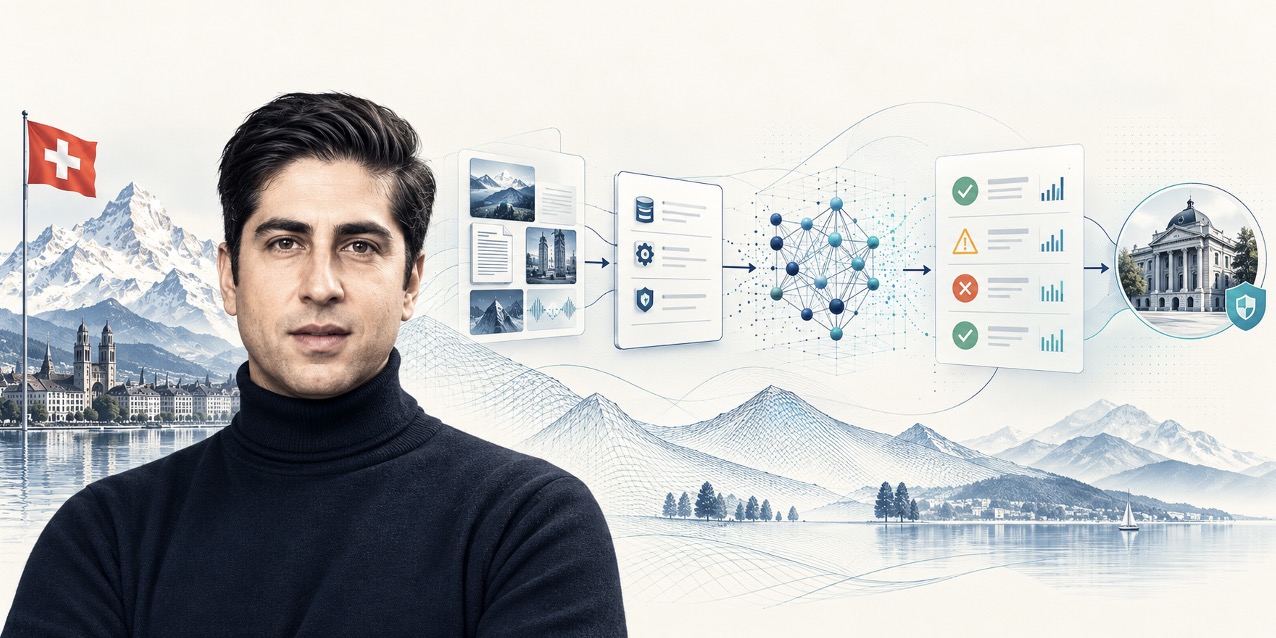
“If you want to work with a bank directly and you are a small 40 people vendor, you know, good luck getting this done in two months.” Dr Petar Tsankov, co-founder and CEO of LatticeFlow AI, describes working out how to reach such customers as one of his personal lessons. His Zurich company tests whether AI systems behave the way their owners and their regulators expect. Its target customers include banks and other large, regulated organisations. Getting to them took years of research, a change of product and the help of partners who already work with those customers.
The Person Behind LatticeFlow AI
Tsankov’s route to Zurich ran through Sofia and Atlanta. According to his academic CV, he started studying computer science at the Technical University of Sofia in 2003, then moved to the United States and completed a BSc at the Georgia Institute of Technology in 2009 with highest honours. He came to ETH Zurich for an MSc, finished in 2011, and stayed for a doctorate in information security. His thesis, completed in 2016, is titled “Access Control with Formal Security Guarantees”.
Guarantees about system behaviour run through his work. After the PhD he joined the Secure, Reliable, and Intelligent Systems Lab (SRI Lab) at ETH, led by Professor Martin Vechev, first as a postdoc and from 2018 as a senior researcher. His CV lists automated security analysis, network configuration synthesis and the safety and robustness certification of neural networks. In 2018 he also co-founded ChainSecurity, which applied automated reasoning to blockchain security; he served as its chief scientist. LatticeFlow AI would be his second company.
Genesis of the Idea
LatticeFlow AI grew out of two ETH research groups. TechCrunch reported in January 2021 that the founders came from Vechev’s SRI Lab and from the Learning & Adaptive Systems group of Professor Andreas Krause. Vechev’s group had built ERAN, a verifier for large deep learning models, which won the first competition for certifying deep neural networks in 2020.
Four people founded the company: Tsankov as CEO, Dr Pavol Bielik as CTO, and the two professors, Vechev and Krause. LatticeFlow AG was entered in the commercial register in Zurich on 16 July 2020. The idea was not quick. Tsankov told the outlet Trending Topics that the team took around four years to develop it, and added: “You have to start with the R&I process, you cannot bypass this step”.
The starting problem was concrete. Bielik explained to TechCrunch that machine learning models are often judged by aggregate metrics such as accuracy, which can hide where a model fails. Swiss Federal Railways (SBB) used LatticeFlow’s tools to build automatic rail inspections; Germany’s Federal Office for Information Security and the US Army were named as further pilot customers.
LatticeFlow AI: The Solution
The first product targeted computer vision. When the company raised its USD 12 million Series A in October 2022, Venturelab described the aim as a platform that automatically finds and fixes data and model problems in computer vision. In the same year LatticeFlow won the Swiss AI Award, competing against around 170 Swiss AI companies, and ranked 64th among the ICT start-ups in the TOP 100 Swiss Startups.
The shift became visible with regulation. In October 2024, ETH Zurich, the Sofia-based research institute INSAIT and LatticeFlow AI released COMPL-AI. It has two parts: a research-based technical interpretation of selected EU AI Act requirements, translating broad regulatory principles into measurable evaluation criteria, and a free, open-source evaluation framework and benchmarks for large language models. The accompanying paper, with Tsankov, Bielik and Vechev among its twelve authors, tested twelve prominent models and found shortcomings in robustness, safety, diversity and fairness. According to INSAIT’s announcement, several high-performing models scored only around 50 percent on cybersecurity and fairness benchmarks, while most did well on harmful content and toxicity. A spokesperson for the European Commission welcomed the work as a first step in translating the AI Act into technical requirements. COMPL-AI is an assessment framework, not an official EU conformity assessment or certification of legal compliance.
Today LatticeFlow AI describes itself as a company for AI risk, governance and security, covering foundation models, enterprise applications and autonomous agents. The principle stayed the same: link a rule to a test that produces evidence. The integrated platform announced on 15 July 2026 takes stock of a company’s AI systems, evaluates their performance and security and governs them over their lifecycle. One component is AI Atlas, launched on 30 April 2026: a public registry of more than 40 frameworks, among them the EU AI Act, OWASP, NIST, ISO 42001 and FINMA, each mapped to technical controls and ready-to-run evaluations. On 24 September 2026, the company announced the AI Risk Center, a managed service in which LatticeFlow’s experts run the assessments and report against risk thresholds the client defines.
Tsankov summed up the approach in January 2026, when LatticeFlow AI bought AI Sonar, a Dublin-based platform for discovering the AI systems in use across an organisation: “AI governance is a technical discipline, much like cybersecurity”.
Market and Context
The regulatory backdrop is the EU AI Act. According to the European Commission, it entered into force on 1 August 2024. Prohibited practices have applied since February 2025, obligations for providers of general-purpose AI models since 2 August 2025, and the Act’s general application began on 2 August 2026. The timetable for high-risk systems has moved: under the AI Omnibus, in force since 27 July 2026, the rules for high-risk use cases listed in Annex III apply from 2 December 2027, and those for regulated products under Annex I from 2 August 2028.
In February 2026 Gartner put spending on AI governance platforms at USD 492 million for 2026 and expected it to exceed USD 1 billion by 2030. On 17 June 2026, LatticeFlow AI announced that it had been mentioned in Gartner’s inaugural Magic Quadrant for AI Governance Platforms. The company’s announcement does not establish a specific quadrant position or ranking.
In the interview, Tsankov explains why such a market is hard to sell into. A start-up that disrupts an existing category can see by industry who invests and who buys. AI governance offers no such map: “The companies are still trying to figure out what roles we need to hire in the organization to solve this problem”. Titles, reporting lines and budgets are still being settled.
LatticeFlow AI’s answer was to define its own measure of AI governance maturity. The team first spoke to everyone, from banking and defence to insurance and retail, then listed the prospects in a plain spreadsheet to avoid chasing whatever had sounded interesting the week before. The criteria that emerged are practical: does the organisation have a team assigned to AI governance, has it written down its rules, how many AI use cases has it deployed, and has it already assessed them? With these questions in place, Tsankov says, a first conversation is enough to place a prospect. Some are ready; others need six or twelve more months.
Challenges and Growth
LatticeFlow’s answer to the bank problem was to go through others. Large advisory firms, the Big Four, Accenture or local consultancies, already work with the banks and want to combine a governance platform, a monitoring tool and their own advice into a full programme. Tsankov tested this by talking to one potential partner after another; after ten, fifteen or twenty such conversations, he says, it became clear which ones could take the offering to market. The public record follows the same line. KPMG Switzerland was named as a strategic partner in October 2024, and in March 2026 LatticeFlow AI announced a partnership with SAP that put its platform on the SAP Store.
Marketing needed a similar correction. The team invested heavily in product releases and advanced technical blog posts, and by his account they went nowhere: “So you will not get TechCrunch writing about your latest release just because you had the release.” What worked was the open-source framework. Each new foundation model gives a reason to publish what is good about it and where its risks lie, in terms anyone can follow; he points to the debate on political bias in Grok and to the biases and security risks he sees in DeepSeek. According to Tsankov, the team has discussed the framework with OpenAI, Anthropic and others. In September 2026 the company published a benchmark of political bias in Chinese and Western language models, built on COMPL-AI.
Plans, he says, rarely survive an emerging market. The team checks its plan explicitly every quarter and has rebuilt it from scratch several times. In his view, leaving a plan is not the problem; holding on to one that is not working is.
The company has grown in steps. A seed round of USD 2.8 million in January 2021 was led by btov and Global Founders Capital. The Series A was led by Atlantic Bridge and OpenOcean, with FPV Ventures participating, bringing the total funding announced by October 2022 to USD 14.8 million, according to Venturelab; this is a historical total, not a claim about cumulative funding as of 2026. Innosuisse has been part of the path. According to the company, LatticeFlow AI received the Innosuisse Certificate in February 2024 after a three-year development programme. In September 2024 Innosuisse approved 33 projects in its Swiss Accelerator call, which had drawn 373 short applications. According to the company, LatticeFlow AI’s project was one of them, with funding of around USD 3 million.
LatticeFlow AI has operations in Zurich and Sofia, and expanded its presence in Dublin through the January 2026 acquisition of AI Sonar. The company also lists an office in San Francisco. This geographical footprint should not be interpreted as confirmation that all locations are standalone R&D sites. Among the organisations it names as users of its platform are SAP, Axpo and Unique AI. With Unique AI it built a technical blueprint that turns FINMA guidance 08/2024 on AI into measurable tests.
Outlook
The postponement of the high-risk rules moves deadlines; the obligations for general-purpose AI models already apply. LatticeFlow AI’s recent launches point towards continuous testing rather than one-off audits. With the AI Risk Center, Tsankov argues, an assessment should not be a report that the next model update makes obsolete.
His advice to other founders is short. Expect many iterations, especially in a new market, and make the learning cycles as fast as possible. His second lesson is the one he calls the biggest: “You cannot control market timing. You just cannot.”
Founders Hive produces this series as part of the Innosuisse Entrepreneurship Training programme. Founder statements are drawn from an interview conducted for this series and from published sources. Interview quotations reproduced here require confirmation against the original recording/transcript before final publication.