

A Deal Only Moves When the Customer Does
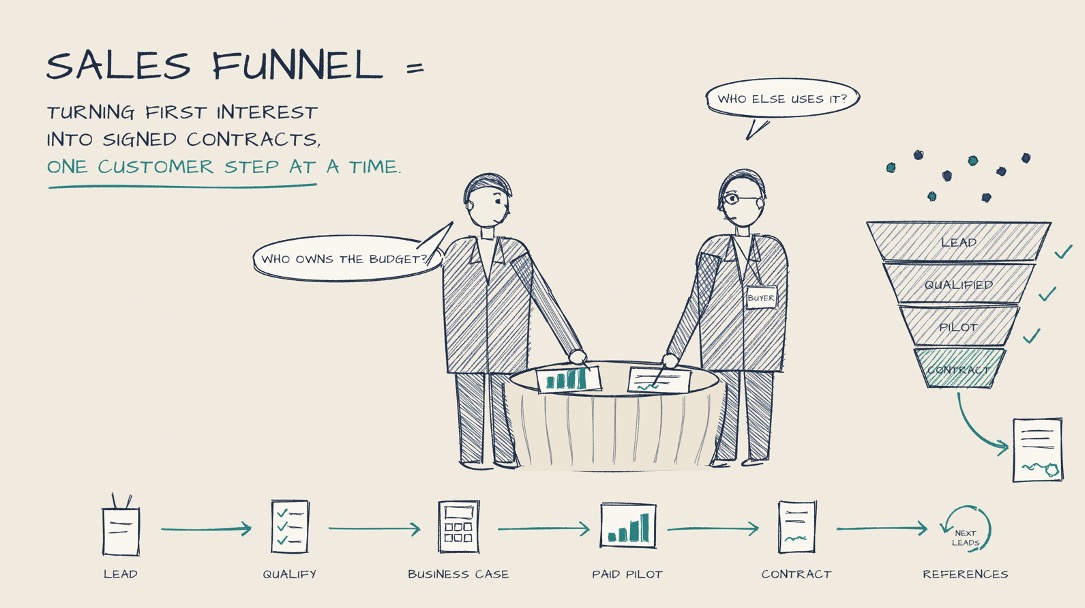
A step-by-step guide to the template Sales Funnel & Lead Qualification in 8 Steps, with lessons from founders of seven Swiss start-ups. Part 3 of the Founders Hive series on go-to-market, commissioned by Innosuisse.
“The secret sauce is in how you define the transitions across these stages,” says Petar Tsankov, CEO of LatticeFlow AI. His funnel itself, he says, is “very standard”. What makes it work is knowing exactly when a deal has moved.
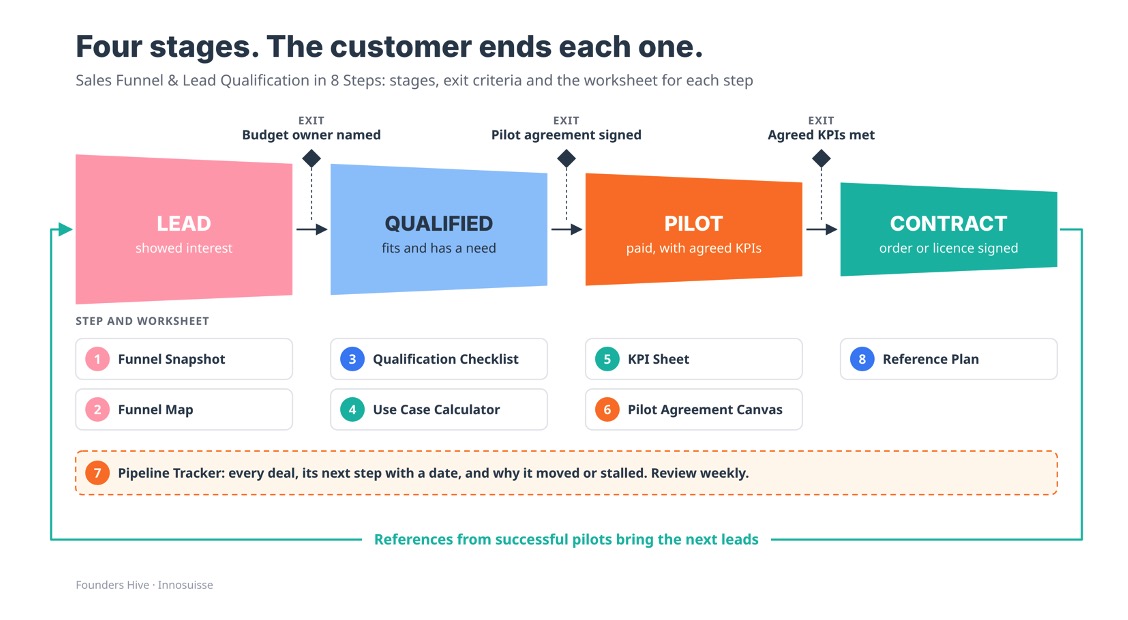
A sales funnel is the path from first interest to signed contract, divided into stages. For a deep-tech start-up with a handful of contacts, four stages are enough: lead, qualified, pilot, contract. Each stage ends with something the customer does, not with a good feeling after a meeting. The template guides you through this in eight steps, one worksheet each. Below is what each step asks of you, and which founder learned it first.
The numbers
- Two to three months, or more than a year. That is how long Tethys Robotics has waited between a first demo and a pilot, depending on the customer.
- About ten salespeople in five years. SmartHelio hired them. Few succeeded, although they had done well in their previous jobs.
- 30 days, not 90. The venture firm Heavybit recommends short paid pilots measured against one business KPI.
Step 1: Take stock of your funnel
Know where every contact stands and who follows up. In a small team, selling is shared. At macu4, which makes 3D-printed prosthetic and orthotic devices, “everybody in the team has to contribute to sales”, and each person looks after a set of leads.
- Worksheet Funnel Snapshot: for each stage, the number of companies today, who follows up and the biggest blocker. Example: “Pilot: 1 company, CEO, waiting for site access.”
Step 2: Map stages and exit criteria
Decide which customer action moves a deal to the next stage. Tethys Robotics, which builds autonomous underwater robots, works with commitments: a demonstration, then a pilot scope defined together, then a letter of intent. LatticeFlow AI checks its stage definitions against its data every quarter and has rebuilt its plan from scratch several times.
- Worksheet Funnel Map: one exit criterion and one owner per stage. Example: a lead becomes qualified once the budget owner is named, a pilot starts once the agreement is signed, and a contract follows once the agreed KPIs are met.
Step 3: Qualify before you invest time
Check budget, authority, need and timing before you offer a demo; sales teams call this BANT. In deep tech, user and buyer are often different people. SmartHelio, whose software predicts faults in solar plants, learned this “quite late”: the operations managers who used the tool had no budget for it. The sale had to go to C-level, who “have to take risk”. Two terms help here. The economic buyer owns the budget. The champion pushes your deal inside the company.
- Worksheet Qualification Checklist: one question per BANT row, the evidence the customer gave, pass or not. Add your own strongest fit signal. SmartHelio uses two: a large, fast-growing solar portfolio and a shortage of operations staff.
Step 4: Build the business case together
Calculate the value with the customer’s own numbers before any pilot starts. heyPatient AG, founded by Regula and Matthias Spühler, digitises the patient journey for hospitals. With its first customer, it “did not start before we had calculated a use case together.” A calculation the customer made is one your champion can defend internally.
- Worksheet Use Case Calculator: one row per use case with cost today, cost with you and payback. Example: inspections cost CHF 120,000 a year today and CHF 80,000 with your system, which costs CHF 60,000 once. The saving is CHF 40,000 a year, so the system pays back in 18 months.
Step 5: Define success upfront
Agree on KPIs and a baseline before the pilot starts, signed off by whoever decides on the roll-out. A proof of concept shows that the technology works; a proof of value shows that it pays off for this customer, and that is what customers buy. SmartHelio asks pilot customers: “If the pilots are successful, will you scale with me?” Where the answer was no, the KPIs did not match the customer’s business, and SmartHelio narrowed its segment.
- Worksheet KPI Sheet: KPI and how it is measured, baseline, target, who signs off. Example: “Unplanned downtime per month, taken from the plant’s own log.”
Step 6: Never run free pilots
A price shows that budget exists. “We don’t do pilots for free,” says Jonas Wüst, CEO of Tethys Robotics. “You need to be at least able to cover your costs.” If a customer refuses to pay anything, go back to Step 3: you are probably talking to a user, not to the budget owner.
- Worksheet Pilot Agreement Canvas: on one page, the scope for both sides, price and duration, the KPIs from Step 5, what follows success (contract, letter of intent or roll-out) and reference rights. Start the price from your direct costs: people, hardware, travel.
Step 7: Track your pipeline
Record every contact from the start. “Definitely you need a CRM from day one, even if you don’t have a product,” says Dr Poorya Amini of Risklick, whose software helps pharmaceutical companies develop clinical trial protocols. A CRM is a system that tracks every customer contact. A spreadsheet will do at first: Tethys Robotics finds that “Excel sheets work just fine” for seven to ten people, as long as you note honestly why a deal moved or stalled.
- Worksheet Pipeline Tracker: one row per company with stage and owner, the next step with a date, and why the deal moved or stalled. Review it weekly. Conversion and win rates only become meaningful once you have enough closed deals to compare.
Step 8: Turn pilots into references
Use every successful pilot to win the next customer, because decision makers first ask whether their peers already use you. Stellos AG, whose software helps real estate owners manage and rent out parking spaces, needed three years to find the customer with the most urgent problem. “Once they had it, then we could go and tell everyone else that they are also using it too,” says founder Mateusz Wojdylo. Risklick used measured use cases with real clients in the same way, to create awareness and referrals.
- Worksheet Reference Plan: per customer, the type of reference (logo, reference call or case study), the peer companies you want to reach and the date you will ask. Agree reference rights in the pilot agreement, not afterwards.
The shortest version
- Define four stages, each ending with something the customer does.
- Find the budget owner before you demo.
- Calculate the business case with the customer’s numbers.
- Agree on KPIs, then charge for the pilot.
- Log every deal weekly and plan a reference for every success.
Keep selling yourself until your story closes deals repeatedly. Only then, says Govinda Upadhyay of SmartHelio, can a sales team repeat it, and even then the founders need to support them.
The template Sales Funnel & Lead Qualification in 8 Steps is available from Founders Hive. Fill in Steps 1 to 3 this week.
Founders Hive produces this series as part of the Innosuisse Entrepreneurship Training programme. Featured founders: Mateusz Wojdylo (Stellos AG), Regula and Matthias Spühler (heyPatient AG), Jonas Wüst (Tethys Robotics), Petar Tsankov (LatticeFlow AI), Poorya Amini (Risklick), Govinda Upadhyay (SmartHelio), Myriam Lingg (macu4).
Pilot length and KPI: Heavybit, guidance on paid pilot programmes. Founder statements are drawn from interviews conducted for this series. Figures marked as examples are illustrations, not data.