

Win One Market Before You Chase Ten
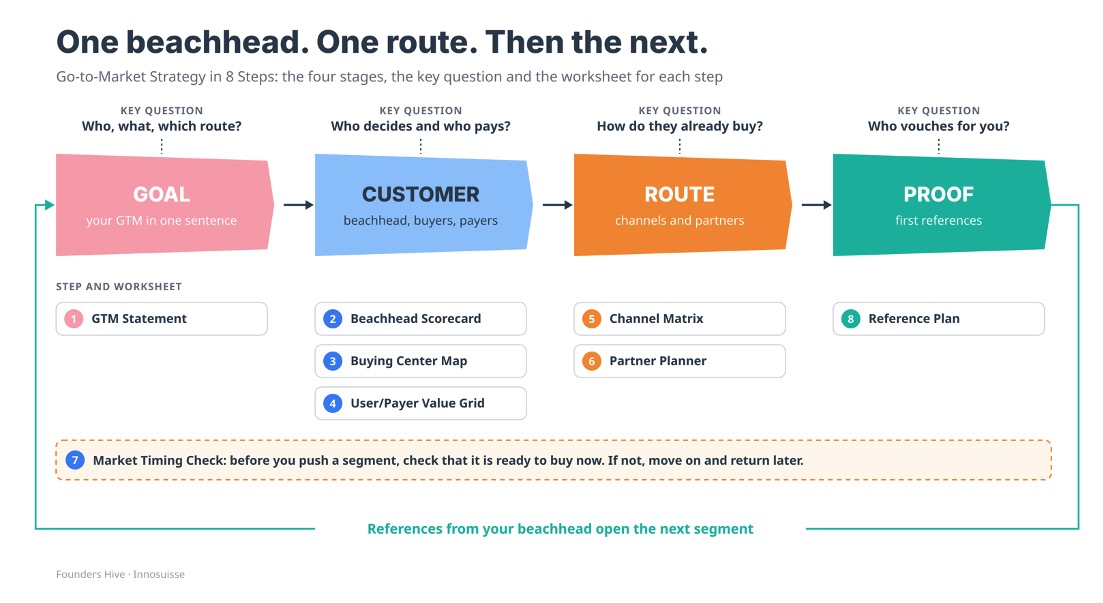
A step-by-step guide to the template Go-to-Market Strategy in 8 Steps, with lessons from founders of seven Swiss start-ups. Part 1 of the Founders Hive series on go-to-market, commissioned by Innosuisse.
“We can support police, hydropower, fish farming,” says Jonas Wüst, CEO of Tethys Robotics, about the underwater robots his team builds. Every one of those markets made some sense. “For us it was therefore important to narrow it down.” Tethys now concentrates on offshore energy.
A go-to-market strategy answers three questions: who you win first, what you offer them and through which route you reach them. For a deep-tech start-up, the first question is usually the hardest, because the technology fits many markets and the team can serve only a few. The template guides you through this in eight steps, one worksheet each. Below is what each step asks of you, and which founder learned it first.
The numbers
- Three associations. Stellos AG reaches the owners, administrators and managers of real estate through the industry’s three associations.
- About three hours by plane. That is how far Tethys Robotics has to fly to reach almost any offshore site in Europe, which is why it focuses on Europe.
- Ten to 20 partners. After talking to that many, says LatticeFlow AI, you see immediately which partners can bring your product to market.
Step 1: Write your GTM statement
Put who, what and route into one sentence before you plan anything else. Stellos AG, whose software helps real estate owners manage and rent out parking spaces, knew its customers early. The route was the open question. Owners, administrators and managers had to see Stellos as “the technology that they can depend on”, and the way to them led through the industry associations. Founder Mateusz Wojdylo joined one, and its innovation challenge, which Stellos won, became the company’s channel.
- Worksheet GTM Statement: who, what and route in one line each, then as one sentence. Example: “For mid-sized dairies that lose milk to undetected cooling faults, we offer a sensor kit through their equipment service partners.”
Step 2: Define your beachhead
Choose one narrow segment you can win completely, then move to the next. Geoffrey Moore calls it the beachhead in his book Crossing the Chasm. Tethys Robotics started with customers close to home, police organisations and hydropower operators in Switzerland, because fast test cycles there did not cost much. Later it moved to offshore energy. Focus, says Wüst, is “how you can concentrate your resources”: on the right exhibitions, the right contacts and the follow-ups you can actually handle.
- Worksheet Beachhead Scorecard: score each candidate segment from 1 to 5 on pain now, ease of reach and word of mouth. Example: “Hydropower operators: pain 3, reach 5, word of mouth 4.”
Step 3: Map the buying center
List everyone who shapes the purchase, not only the person you met. Frederick Webster and Yoram Wind described the roles in 1972: user, influencer, buyer, decider and gatekeeper. Stellos AG identified nine different decision makers in the purchase of parking alone. heyPatient AG, founded by Regula and Matthias Spühler, digitises the patient journey for hospitals. It builds a buying center for every customer and records the decision makers and influencers in its CRM. Large hospitals buy through official tenders; smaller ones have other ways of buying.
- Worksheet Buying Center Map: role, name, main concern and influence for each person. Example: “Head of IT: worried about integration effort, can veto.”
Step 4: Separate user and payer
Find out who uses your product and who pays for it, and make a case for each. Govinda Upadhyay of SmartHelio, whose software predicts faults in solar plants, travelled to the technicians who act on its recommendations, then met their managers and the C-level to understand the value at each level. He also learned that companies keeping their plants on the balance sheet wanted the software, while those building plants to sell them did not. In healthcare, heyPatient adds a question: “You need to know who is paying what. It’s not the user.”
- Worksheet User/Payer Value Grid: for the user, the manager and the budget owner, the person, their main pain and the value they get. Example: “Budget owner: CFO, unplanned downtime, fewer lost operating hours.”
Step 5: Choose your channels
Decide whether you sell directly, with partners, on a marketplace or through an association. LatticeFlow AI, which tests and governs AI systems for companies, found that selling directly to banks is slow for a small vendor. “If you want to work with a bank directly and you are a small 40-people vendor, good luck getting this done in two months,” says CEO Petar Tsankov. Consultancies that already work with these banks are a faster way in. Stellos AG tried cold email once and learned that “you cannot build trust over email”; it meets decision makers at small evening events instead.
- Worksheet Channel Matrix: for direct, partner, marketplace and association, the fit with how your customers buy, the effort and the first step. Example: “Association: high fit, low effort, register for the next member event.”
Step 6: Leverage platforms and partners
Use the reach and procurement access of larger players. heyPatient sells through the Microsoft Marketplace: a customer in England can buy the solution, pay Microsoft and skip a separate procurement process. heyPatient calls it “a huge enabler”, and the Siemens Xcelerator marketplace opens further markets. macu4, which makes 3D-printed prosthetic and orthotic devices, asks of every partner why it wants to work with macu4 and what hidden risks the deal holds. It avoids using the same partner in every country and prefers large partners, so it can switch if something goes wrong.
- Worksheet Partner Planner: per partner, what they bring, what they need from you and the main risk. Example: “Hospital software provider: installed base of clients, needs a certified interface, depends on their release cycle.”
Step 7: Time your market
Check whether a market is ready to buy now. Myriam Lingg, CEO of macu4, still meets markets that doubt 3D-printed products can perform mechanically, a doubt macu4 saw in Germany three years ago. “The thinking is rigid and you cannot force them to change,” she says. When a market is not yet ready, macu4 moves on to the next one to gain time. LatticeFlow AI, working in a market that barely existed, defined its own readiness criteria: an AI governance team, governance rules, deployed use cases and completed assessments. Today it can place a new prospect within about 30 seconds.
- Worksheet Market Timing Check: per market, the readiness signals you see, a score from 1 to 5 and your decision: now or later.
Step 8: Plan your first proof points
Turn your first customers into evidence the next ones believe. Risklick, whose software helps pharmaceutical companies develop clinical trial protocols, convinced some clients to run a real use case so that “we can really measure the impact”, says Dr Poorya Amini. Those use cases created awareness, and the network and referrals opened doors to the right people in large organisations. SmartHelio invites customers to its webinars to present their case studies themselves.
- Worksheet Reference Plan: per customer, the metric to prove, the format (case study, webinar or reference call) and a target date. Agree reference rights before the pilot starts.
The shortest version
- Write who, what and route in one sentence.
- Pick one beachhead you can reach fast and win completely.
- Map everyone who decides, and find out who pays.
- Choose the route your customers already use, and test partners before you commit.
- Check that the market is ready, then plan your first references.
Expect your plan to change. “The original thinking which you have is surely not the one which you will have after a couple of years,” says Myriam Lingg of macu4. A written plan shows you what to adapt.
The template Go-to-Market Strategy in 8 Steps is available from Founders Hive. Write your GTM statement this week.
Founders Hive produces this series as part of the Innosuisse Entrepreneurship Training programme. Featured founders: Mateusz Wojdylo (Stellos AG), Regula and Matthias Spühler (heyPatient AG), Jonas Wüst (Tethys Robotics), Petar Tsankov (LatticeFlow AI), Poorya Amini (Risklick), Govinda Upadhyay (SmartHelio), Myriam Lingg (macu4).
Beachhead: Geoffrey Moore, Crossing the Chasm. Buying center roles: Frederick Webster and Yoram Wind (1972), summarised by The Open University. Founder statements are drawn from interviews conducted for this series. Figures marked as examples are illustrations, not data.