

Growth in B2B Starts with a Test You Can Lose
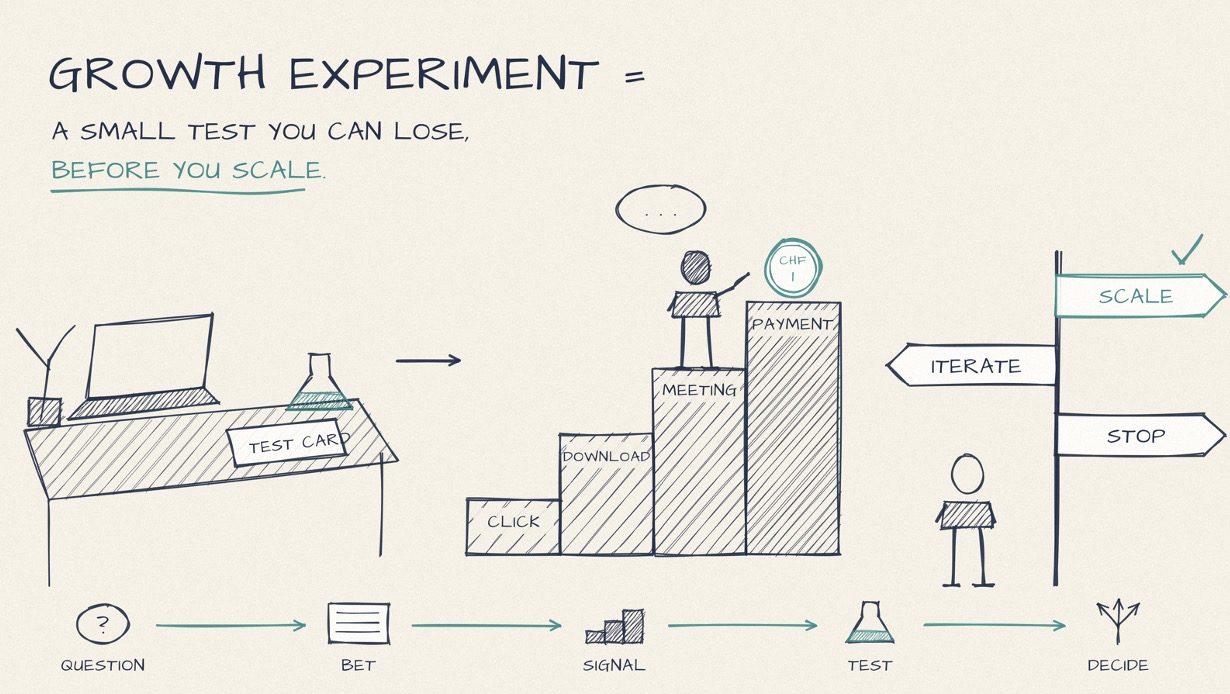
A step-by-step guide to the template Growth Hacking & Experiments in 8 Steps, with lessons from founders of seven Swiss start-ups. Part 4 of the Founders Hive series on go-to-market, commissioned by Innosuisse.
“Unless the person has paid for it, it’s still zero,” says Govinda Upadhyay of SmartHelio. Downloads, sign-ups and friendly feedback feel like progress. They do not show that anyone will buy.
A growth experiment is a small, time-limited attempt to win customers, with the result that counts as success written down before you start. The template picks up where Step 7 of Business Model Design (Validation & Iteration) ends. Steps 1 to 3 design one experiment, Step 4 runs it, Steps 5 to 7 cover channels, pricing and platforms, and Step 8 closes it with a decision. Each step has one worksheet. Work on one experiment at a time.
The numbers
- Most experiments fail. At Google and Bing, only about 10 to 20 out of 100 experiments produce a positive result.
- Six months to a year. That is how long SmartHelio needs to win a large B2B customer, so you need earlier signals than a contract.
- 3 to 5 in 100. A good self-serve freemium product turns this share of free users into paying customers.
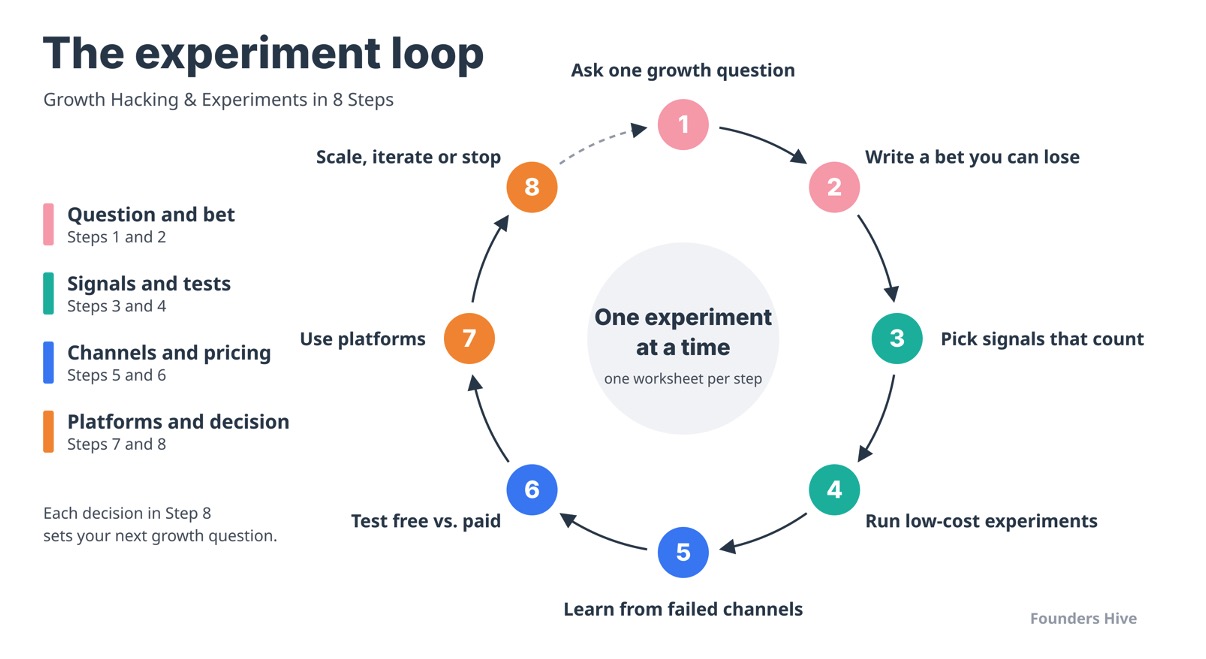
Step 1: Ask one growth question
Find the stage where you lose most potestrongi
al customers: when they hear of you, try you, come back, recommend you or pay. Ask one question about it and pick the number that answers it. After every event, SmartHelio counts QR code downloads and “I would love to try” replies, but only as a pre-test. The real question is whether anyone pays.
- Worksheet Growth Question: funnel stage, segment, desired behaviour, signal. Example: “Revenue; lab managers; book a paid pilot; signed pilot offer.”
Step 2: Formulate testable hypotheses
Turn your assumption into a bet a test can prstronge
wrong. Change one thing per test and put a number and a deadline on the result, for example 4 of 20 contacts in six weeks. With samples this small, the threshold is a decision rule, not a statistical proof. macu4, which makes 3D-printed arm prostheses, deliberately looks for the most demanding customer during development: “From this type of customer we learn best,” says CEO Myriam Lingg.
- Worksheet Hypothesis Card: We believe (who has which problem), We test (the cheapest action that shows it), We know when (the threshold). Fix the threshold before you start.
Step 3: Pick signals that count
Compliments are free, so they prove notstrongn
g. Count what costs the buyer something: time, an introduction to a colleague, access to data, money. LatticeFlow AI wrote advanced technical blog posts around its releases, without measurable results. “You will not get TechCrunch writing about your latest release just because you had the release,” says CEO Petar Tsankov. A public open-source framework that anyone could download and run worked far better and led to sales conversations.
- Worksheet Signal Ladder: for each rung (click, download, meeting, payment), note the event you count, a target and the actual figure. Watch the share that moves up a rung, not the totals.
Step 4: Run low-cost experiments
The template names three cheap formats. strongs
moke test presents an offer that does not exist yet; Dropbox tested demand with a short demo video. Earned visibility replaces paid ads: Stellos AG, which helps property owners rent out parking spaces, gave interviews, joined an industry association and, still named ShareP, won the Swiss round of the ULI Europe PropTech Innovation Challenge in 2023. A nearby pilot uses customers you can reach fast: Tethys Robotics started with police units and hydropower operators in Switzerland.
- Worksheet Experiment Canvas: idea, ICE score (Impact, Confidence and Ease, each 1 to 10), cost and time, result. Run the top scores first and give each test an end date.
Step 5: Learn from failed channels
A channel that does not convert usually fastrongs
for one of two reasons: you reached the wrong person, or the right person said no to your offer. Stellos briefly tried cold email; one prospect replied, “Please never contact me again.” At trade fairs, Tethys mostly met people who wanted to sell something, not future users. Referrals from people who had seen its underwater robot at work led straight to the right contact.
- Worksheet Channel Post-Mortem: channel, expected, happened, root cause. If you reached the wrong person, fix the targeting. If the right person said no, fix the offer.
Step 6: Test free vs. paid
A free version shows interest; a pstrongm
ent shows budget. SmartHelio tried freemium several times. “Whenever we have tried freemium, it went very badly,” says Upadhyay. Customers first need to trust the company and the software; then they pay. In a niche market, the arithmetic is against free: even if all 300 potential buyers signed up, a good conversion rate would leave 9 to 15 paying customers.
- Worksheet Pricing Experiment Sheet: offer, price, segment, conversion. Test a paid pilot with a clear scope. Example wording: “Eight weeks for CHF [amount]; if we reach [agreed result], the fee counts towards the first year’s licence.”
Step 7: Use platforms as growth engines
Sell where your buyers already buy. heyPatient strong,
founded by Regula and Matthias Spühler, can be purchased worldwide through the Microsoft Marketplace, without a separate procurement process. A customer in England pays Microsoft, and Microsoft pays heyPatient. The company also prioritises customers who already use an integration partner’s software, because it can show that the link works there.
- Worksheet Platform Checklist: platform, who buys there, effort to list, next step. Include marketplaces, partner software and communities such as open-source projects or industry associations.
Step 8: Decide to scale, iterate or stop
Close every test on a date set in advance: scalestrongt
if it beat the threshold, change one thing and rerun it if it came close, stop it if it clearly missed. Then write it down. Dr Poorya Amini of Risklick advises setting up a CRM, a system that tracks every customer contact, from day one, even before there is a product. Risklick connects its email to the CRM: “With the minimum effort, we can capture the maximum information,” he says. A spreadsheet works too, says Jonas Wüst of Tethys, if you note honestly why each lead moved on or not.
- Worksheet Experiment Log: experiment, result against threshold, decision, learning. Review it at a fixed rhythm, for example monthly.
The shortest version
- Ask one growth question and write one bet with a threshold.
- Count steps that cost the customer something, not contacts.
- When a channel fails, check whether you reached the wrong person or made the wrong offer.
- Ask for payment before you give anything away, and sell where buyers already buy.
- Close every test with scale, iterate or stop, and log the reason.
The template Growth Hacking & Experiments in 8 Steps is available from Founders Hive. Fill in Steps 1 to 3 this week.
Founders Hive produces this series as part of the Innosuisse Entrepreneurship Training programme. Featured founders: Mateusz Wojdylo (Stellos AG), Regula and Matthias Spühler (heyPatient AG), Jonas Wüst (Tethys Robotics), Petar Tsankov (LatticeFlow AI), Dr Poorya Amini (Risklick), Govinda Upadhyay (SmartHelio), Myriam Lingg (macu4).
Sources: Ron Kohavi and Stefan Thomke, “The Surprising Power of Online Experiments”, Harvard Business Review, September/October 2017. Kyle Poyar and Lenny Rachitsky, “What is a good free-to-paid conversion rate?”, Lenny’s Newsletter, 1 August 2023. Eric Ries on Dropbox, TechCrunch, 19 October 2011. ULI Europe, PropTech Innovation Challenge winners, 12 September 2023. Founder statements are drawn from interviews conducted for this series. Thresholds and wording marked as examples are illustrations, not data.